
Custom Sterling Silver Jewelry for Jewelry Brands
A sterling collection is easier to source when six things are fixed in writing before a mould is cut: base metal, plating, chain, stones, hallmark and packaging. The published route sets the floor at a 50-piece MOQ per design in 925 sterling silver, with CAD under 48 hours and a 25–30 day window for a physical master sample.

Key takeaways
- Six customisation points — base material, plating, chains, stones, hallmarks and packaging — are decided in that order.
- 50 pieces per design is the silver floor, half the 100-piece brass threshold.
- CAD lands under 48 hours, while a master sample runs 25–30 days.
- NDA terms keep CAD, moulds and the collection exclusive to the brand, and final QC inspects 100% of pieces.
Metal, mark and the six decisions
Sterling means 925 silver, and the published marking option is S925. The mark is a statement about the core metal. It says nothing about the finish, the stones or the clasp, which is why those items belong on a separate line of the specification.
Base metal is the first decision because it constrains every later one. Silver takes rhodium and gold plating, accepts an anti-tarnish coating, and suits stone setting and fine chain. The brass line uses artisan eco-brass and the stainless line uses 316L or 304, each with its own finishing route. Choose the metal first; the rest of the sheet follows from it.
Compliance sits inside the metal choice. The published position is that materials are REACH compliant and free of lead, cadmium and nickel, and that plating is 100% compliant with REACH and CA Prop 65. A brand selling into the EU or California should treat that as a floor, then check the destination market's own labelling rules.
The material statement behind these choices is published at https://www.tttjewelry.com/sterling-silver-jewelry-manufacturer/, and it is the page worth circulating to a buying team before a brief is written. It gives the factory and the brand the same vocabulary for the first conversation.
The published customisation menu lists six points: base material, plating and finishes, chains and findings, stones and accents, custom logo and hallmarks, and packaging. They are not a checklist to be filled in any order. Each one narrows the next.
Plating colour has to suit the metal and the stone. A rhodium finish reads cool and pushes a white topaz towards blue-white; an 18K gold finish warms the same stone. Chain alloy has to match the pendant, or the two pieces will age differently in wear. Stone setting has to be settled before CAD, because a bezel and a prong setting are different geometry, not different decoration.
Hallmark placement affects polishing, and packaging affects the packing line. A hallmark cut into a mirror surface must be engraved after plating, while a hallmark on a matte back can be struck earlier. A foil-stamped box with a display card adds a packing step that a plain pouch does not.
| Decision | Published option | What it locks | Cost of leaving it open |
|---|---|---|---|
| 1. Base material | 925 sterling silver, brass, stainless steel | Plating route, weight, setting method | Re-quote and a new CAD file |
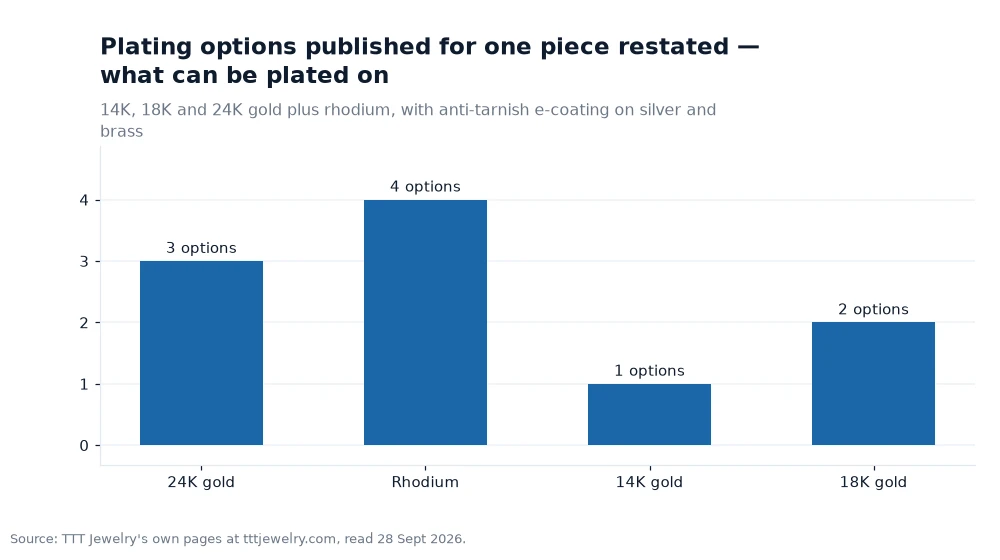
| 2. Plating | 14K, 18K, 24K gold, rhodium; e-coat on silver | Colour, wear behaviour, hallmark order | A second sample round |
| 3. Chains and findings | Chain type, clasp, jump ring | How the piece hangs and wears | Mismatched ageing between parts |
| 4. Stones and accents | Natural stones, freshwater pearls, CZ, birthstone | Setting geometry inside the CAD | Redrawn setting and a later sample |
| 5. Logo and hallmark | Laser engraving; S925, 316L, 18KGP | Where the mark sits and when it is cut | Mark over a plated face |
| 6. Packaging | Logo tags, foil boxes, velvet or microfibre pouches, backing cards, barcode labels | Packing time and retail presentation | Repack at the warehouse |
Plating on silver: four colours and a barrier
The plating menu publishes four finishes: multi-layer 14K gold, 18K gold, 24K gold and rhodium. On silver, rhodium gives a white surface that resists wear, while the gold tones move from pale to deep as the karat rises. Layer count is part of the specification, not an automatic upgrade.
An anti-tarnish e-coating is available on silver and brass and is applied after plating. Its job is to slow the sulphur reaction that darkens silver in air. It is a barrier, not a colour, and it should be named on the spec sheet because a coated and an uncoated piece of the same colour will age differently on a display stand.
For a mixed-material collection, gold-coloured silver and gold-coloured stainless will not be produced by the same method. Silver is electroplated; stainless is PVD coated. Brands that want a matched look across both should compare physical samples rather than colour references, and should read the custom brass jewelry line as well, since brass sits between the two on cost and finishing.
Chains, stones and the parts buyers forget
Chains and findings are a separate published option for a reason. A pendant head can be perfect and still fail at retail if the chain is too fine for the weight, or if the clasp tarnishes ahead of the pendant. Chain and clasp should be named on the same sheet as the head, in the same metal and finish.
Stones and accents cover natural stones, freshwater pearls, cubic zirconia and birthstone. Each brings a different setting constraint: pearls are drilled and mounted, faceted stones need a seat cut to their girdle, and small accents need enough metal around them to survive polishing. Those decisions belong in the CAD brief, not in a comment on the first sample.
Packaging is the sixth point and the one most often left to the last week. Metallic logo tags, foil-stamped gift boxes, velvet or microfibre pouches, display backing cards and barcode labelling all change what happens after inspection. A brand that plans a gift-with-purchase launch should decide the box before the production run, not after it.
What one sample round actually proves
CAD modelling is published at under 48 hours, and the master physical sample at 25–30 days. The sample is where a brand judges the things a render cannot show: how the plate sits on a curved surface, whether a stone reads the intended colour, and whether the clasp feels right in the hand.
That 25–30 day window is also the reason to settle the six decisions early. A sample built to an incomplete brief answers fewer questions, and the next round costs another 25–30 days. Under the published terms, designs remain exclusive to the brand under a 100% NDA, and a dedicated project manager carries the file, which helps when several decisions are moving at once.
Worked example
A brand plans three designs at the silver minimum: 3 × 50 = 150 pieces. At the brass threshold of 100 per design, 150 pieces would not cover two designs, so the practical brass equivalent is 2 × 100 = 200 pieces. The silver route therefore delivers three designs for 150 pieces, where brass needs 200 pieces to reach two.
Now add plating comparison. If each finish is sampled on its own round and the brand tests all four published finishes, that is 4 × 25 = 100 days at the short end and 4 × 30 = 120 days at the long end. Reviewing two finishes per round halves the calendar without changing the number of samples.
Finally, the per-design arithmetic: 150 pieces across three designs is 50 per design, but 150 pieces in one design would sit above the minimum and lower the per-piece share of fixed tooling. The minimum is a floor, not a target, and splitting it thinly is the choice that raises unit cost.
Frequently asked questions
What is the minimum order for a new sterling silver design?
50 pieces per design is the published silver minimum, which is half the 100-piece threshold for the brass line and below the 100+ piece stainless threshold.
Does changing the plating colour require a new sample?
Yes, because colour is approved on a physical master, so a change after sign-off reopens the 25–30 day sampling window and should be treated as a schedule item.
Who owns the CAD file and the mould?
The brand does. Published terms include a 100% NDA, with designs, moulds and the collection kept exclusive and not resold or shown to other buyers.
Briefing a factory before the drawing is finished
Not every brand arrives with a complete CAD file. The published OEM model builds to the buyer's drawing, while the ODM model develops the concept with the factory and keeps the result exclusive to the brand. Both start from the same six decisions.
The OEM/ODM jewelry manufacturer page sets out the six-step flow from inquiry to delivery, which is useful for mapping internal design reviews onto factory milestones.
A brand that writes the metal, finish, chain, stone, hallmark and pack into one document gives the sample bench a fair chance to get it right on the first pass. That document is also the baseline for every reorder that follows.
Source note: figures come from the manufacturer's own website (tttjewelry.com), read 28 Sept 2026.[1]